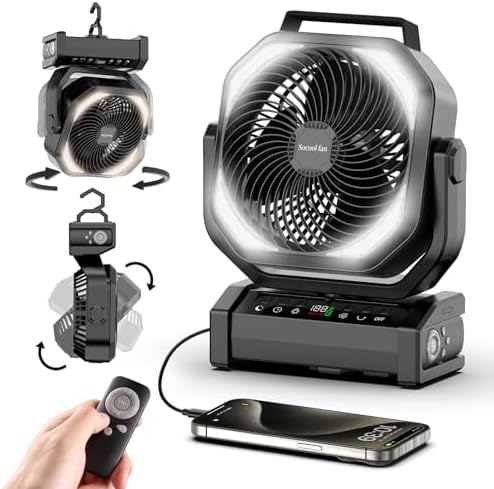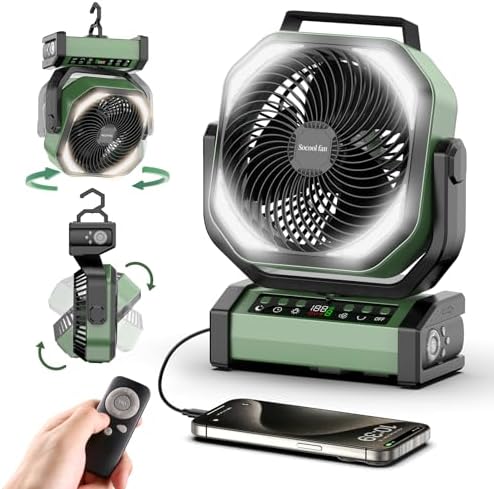
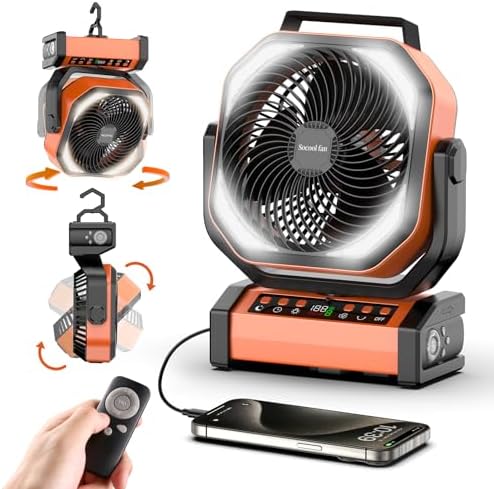
Two campsite devices in one hanging body, offered in two sizes. The 8.5-inch head runs nine speeds — the ninth a natural-wind simulation — throwing air at 14.7ft/s up to eighteen feet, carries sixteen LEDs across three brightness levels up to 400 lumens, and is rated for 112 hours on its 20,000mAh pack. The 10-inch head puts four speeds and a 1650RPM rotor behind 16.07ft/s of airflow reaching twenty-three feet, doubles the ring to thirty-two LEDs and runs 136 hours on low from 40,000mAh, with 5V-3A charging in and out. Both share the rest: automatic 45° or 90° oscillation widening coverage to 135°, a head pivoting through 270°, a digital display, a hidden hook for a tent ridgeline, a docked remote, 1/2/4/8-hour timers and under thirty decibels on the lowest speed.
Opens the authorised listing for the size you selected. The price here is re-checked regularly; the binding price is the one at checkout.
Hung from a tent ceiling it replaces two items on the packing list. The oscillating head keeps air moving over sleeping bags while the LED ring lights the tent for cards or reading, dimming to a soft level that will not wake anyone. Set the timer and both shut off after everyone is asleep — no crawling over bodies at midnight to find a switch.
The light deserves specifics. The smaller head carries sixteen LEDs across three levels reaching four hundred lumens; the larger one doubles the ring to thirty-two. At the lowest level either is a reading lamp, at the highest it lights a family tent well enough to find whatever somebody lost. For most trips it simply removes the lantern from the list.
At home it is a legitimate bedroom fan. Under thirty decibels on low is sleep-quiet, the digital display means no squinting at indicator dots to guess the charge, and the 270° pivot plus oscillation covers a bed as evenly as a tent. On the 8.5-inch head the ninth speed is a natural-wind mode rather than the strongest setting — the eighth is maximum, which is worth knowing before judging the fan.
During an outage the USB output keeps phones alive while the ring does lantern duty. That is the third role the hardware was designed for, and the reason these fans end up in storm bins as often as camping boxes: moving air, area light and phone power from one thing that needs topping up once a season. The 10-inch build is the one to pick for that job — a bigger ring, a longer reach and 136 hours of reserve.
Auto 45° or 90° oscillation widens the airflow to 135°, and the head pivots 270° on top of that.
Sixteen LEDs reaching 400 lumens on the 8.5-inch head, thirty-two on the 10-inch — reading lamp to tent floodlight.
A brushless motor under 30dB on low, with 1/2/4/8-hour timers for overnight running.
Air at 14.7ft/s over eighteen feet, or 16.07ft/s over twenty-three on the larger head.
A digital display shows charge, speed and timer instead of blinking dots.
Hooked to the ridgeline at dusk: light on the middle level for dinner, fan sweeping the sleeping bags, timer set to four hours so the whole rig shuts itself down.
Under thirty decibels on low is quieter than many purpose-built sleep machines; it runs at the bedside all summer and lasts a week of nights per charge.
In the outage bin it covers three roles at once — moving air, an LED area light and phone charging from the USB port.